
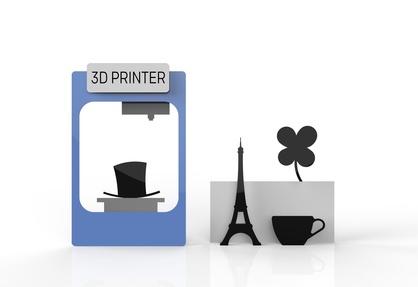
What is a 3D Printer?
A 3D printer is an automated computer printer that builds solid objects using instructions from a computer file. The computer file includes three dimensions of length and width and depth to create the 3rd dimension needed for an item instead of a printed diagram.
Adding and Subtracting to Make Solid Objects
3D printers create objects using by "printing" many thin layers thin of liquid material that dries to a solid shape. These layers are printed one at a time, but when added together, they create a 3 dimensional solid object. Adding layers together is called an "additive" process for creating an object. You might be familiar with wood carving, where the wood carver removes wood to create the sculpture. The carving removes material to create the object, and it's called a "subtractive" process. Much of our manufacturing has been subtractive, where we use tools and machines for removing material to create the shape of the object we want. 3D printers add many thin layers one at a time to create and build an object.
Add enough layers together, and you can create a solid object. If you need to make something thicker, adding layers to it is a way to make something that is thin, thicker. Think of a sheet of paper, since it's pretty thin. Add 500 sheets together in a stack (which, by the way, makes a ream of paper), and you've got a thick object. Instead of keeping each sheet of paper separate, imagine that they are glued together into a solid piece of material, and you've got a block, not 500 sheets.
Making Deposits with a Printer
Ink-jet printers use tiny nozzles to spray a thin layer of ink on paper. Using instructions from a computer, the ink-jet printer deposits tiny dots of ink in all the right places to print letters and photos. If you've ever sliced any food in your kitchen, you know that large objects can be sliced into layers, like a tomato. While your skills in slicing may be pretty good, a computer with the right software can take any solid object and "slice" it into really thin layers. If you could put the slices of your tomato back together, you've got a whole tomato. So now, let's use slices to create something new.
Printing an Object
Now, let's say you want to create a chess piece. If you can create a computer diagram of the chess piece made up of slices, so that when all the slices are added together, you get a chess piece, you've got some idea of how the software for 3D printing works. It's not too different from your kitchen slicing, just finer and more precise (no offense at precision kitchen slicers meant here.) Each time the printer prints a layer, it moves itself left, right, and for a 3D printer, it can move also move up and down in the 3rd dimension. Instead of printing each slice with ink, the 3D printer uses a liquid material, like a plastic, for each layer of the chess piece. Moving up just a fraction of an inch for each payer, the printer deposits an additional layer of material one layer at a time. Each layer of plastic is liquid enough to keep it's shape and join with the next layer as the plastic cools. So when all the layers are "printed," you've made a complete chess piece.
Types of 3D Printers
3D printers are made in a wide range of process, sizes, and for use with different printing materials. They range in size from desktop models slightly larger than a typical desktop printer to large industrial models that can print large solid objects at high speeds. Different models make use of different materials for the solid printed object. Some models use plastics, and others use liquid metals and can be used for manufacturing industrial products.
Prices are coming down on 3D printers all the time, and there are models now available for under $500.00. As a result, more people are buying them, and more product plans are being created all the time. Web sites are available that offer designs for 3D printers. A popular one is Thingverse (www.thingiverse.com) created by Makerbot, one of the most popular 3D printer brands. At Sculpteo (http://www.sculpteo.com), you can create and publish designs for objects that people can order on the Web for printing at Sculpteo and then have it shipped to their home or office.
The Future of Manufacturing and 3D Printing
While 3D printing isn't ready yet to replace low-cost assembly and manufacturing, it's getting closer all the time. Instead of stocking replacement parts for an item like cars and household products, they can be printed on demand and shipped. With no need to keep inventory on hand, it's possible to manufacture parts for products that have no spare parts inventory. Items that were un-repairable before because of a lack of a part can become repairable and last longer if the design is available for a 3D printer.
With 3D printing, custom made products will be more common. Instead of having to rely on manufacturing a product in large volumes to lower costs, someday you will be able to order your product with customized options manufactured just for you. Complex objects with unusual shapes and patterns won't be a problem with 3D printers so that designers can try new and creative approaches.
3D printing isn't just changing products, it's also changing medicine. A new company, Organovo (www.organovo.com), is developing bioprinted human tissue for therapeutic and research uses. I'm sure we haven't seen all the uses for 3D printing. As 3D Printing becomes more widely available, you might even be able to order your coffee in a custom mug that's manufactured while you wait.
Not a subscriber? Sign up to receive the weekly newsletter and don't miss a single issue: