
What is Biometrics?
Biometrics is the measurement and analysis of the unique personal characteristics of an individual, primarily for the hte purpose of verifying a person's identity. Your fingerprint, voice pattern, face, teeth, footprint and walking gait are all biometric characteristics unique to you as an individual. When you see someone you recognize from behind, you might see a familiar walk or body shape, when they turn around, your brain knows that person and identifies them. Biometric technology measures and evaluates physical or behavioral patterns of individuals and digitizes the data for use in computer applications. One of the most common uses of biometrics is for personal identification.
Biometric sensors
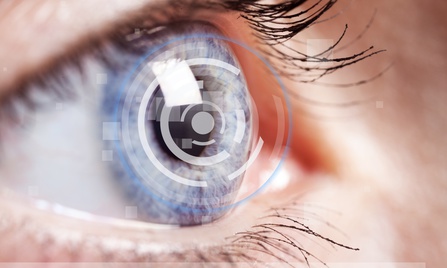
You might have seen a movie or TV show where one of the characters places their eye up to a sensor that scans their eye to identify the individual. This biometric sensor uses a retinal scanner to scan the eyeball and check a computer database to see if the person's pattern is on file for access to unlock a door. If the person's scan is in the database and they are allowed access, the computer application gives them access.
Retinal scanners require that a person be physically present to be scanned, so in comparison to other locks and digital access systems they are more secure. Organizations that use identification cards for access through a card reader have a security gap when compared to biometric identification. If someone else can get their hands on an employee's security ID, then that person can swipe the card to gain access. Biometrics increases security by making the person's physical characteristic (their retina) a replacement for any physical card.
The ability to steal and use a physical card and use requires a second layer of security, which is why our bank ATM cards require a passcode and we are receiving credit cards with a chip that requires a passcode to approve a purchase. The combination of the physical card and passcode offers increased theft and identity protection. Biometrics, however, can improve identification even further.
Smartphones and fingerprints
Newer of models of both iPhone and Android phones use a fingerprint sensor for identification. This sensor uses biometrics to read your fingerprint and compare it to the data stored on your smartphone to see if the fingerprint is you. If it is, your smartphone unlocks. The ridge pattern of your finger is recorded by the sensor when you set up your smartphone. When you place your finger on the biometric sensor, it “reads” you ridge pattern to unlock your phone or authorize a payment from an app. Fingerprint biometrics rely on the fact that a person's fingerprints don't change much over time and there are virtually unique.
The uniqueness of a person's fingerprints has been accepted over time because there's not much that contradicts this premise. There are some web articles that say it's possible for two people to have the same fingerprints, but even identical twins have different ones.
How fingerprints are measured can affect their accuracy, which is why they are challenged. The more accurate the measurement, the less likely it is for a mistaken identification to occur. Biometric computer sensors are very accurate and detailed, so your fingerprint, along with the fact that you have to hold your smartphone in your hand, make it easy to use biometrics to identify you.
Other types of biometrics
If it can be measured and analyzed, there's a good chance that someone's developed a biometric sensor for some characteristic. Your face, speech patterns, retina, and DNA are all physical features that can be measured by technology. Software programs use the measurements and a database of information to identify an individual. But biometrics is used for more than personal identification and the applications are expanding.
Athletics and sports medicine are two areas that use biometrics to measure a person motion and evaluate it for feedback. IN the case of an athlete, shaving fractions of a second off an event can make the different in winning, so biometrics gives coaches the ability to use not only their eyes but also computer programs to evaluate how an athlete moves and what effect changes would have on their performance.
Medical analysis of movement can help speed up physical therapy with programs that have expert recommendations and can detect details that might not appear to an observer. Going one step further, biometric sensors have made artificial limbs and even replacement retinas possible, connecting the sensors directly to a person's nervous system and gives them the ability to control an artificial limb with their thoughts.
To my way of thinking
Biometric technology is making it easier for us to be ourselves and minimize the need to carry around physical forms of identification. Since you're unique, all that's needed is a good enough sensor to read your retina, fingerprint, voice, or other physical property to identify you as you. Hospitals are relying upon biometrics to identify and track patients; financial institutions are relying on biometric sensors for identification and recording transaction history, and of course, your smartphone is becoming a more powerful biometric device with fingerprint reading built-in.
Biometrics and the improvements in technology sensors and applications are giving sight to people who were always thought to be blind, and as biometric technology becomes more sophisticated and lower in cost, it will be used in more and more applications from our cars to our homes.
Not a subscriber? Don't miss a single issue:
Websites:
Biometric Update Wesbite on Biometrics
http://www.biometricupdate.com/biometric-news/healthcare-biometrcis
Michigan State University Anil K, Jain The Uniqueness of Fingerprints
http://biometrics.cse.msu.edu/Presentations/AnilJain_UniquenessOfFingerprints_NAS05.pdf