
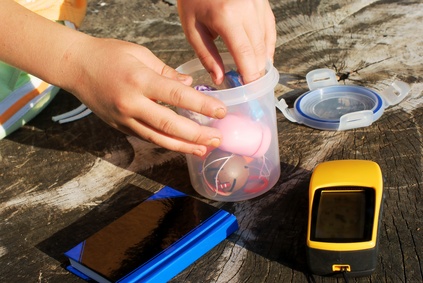
What is Geocaching?
Geocaching is an outdoor recreational treasure-hunting game that uses the Global Positioning System (GPS) to identify locations where containers are hidden for the game players (anyone can play) to find. Volunteers of all ages and backgrounds hide the geocache containers of various shapes and sizes all over the world and post the GPS coordinates online on one or more geocache websites.
The goal is to use the GPS coordinates to search for the geocache. Volunteers of any background can create a geocache or search for one, and the whole activity of geocaching is essentially non-commercial. If you're familiar with a scavenger hunt, just think of geocaching as the modern high-tech version on a global scale.
What's the goal?
As a recreational activity, the goal of geocaching is to have fun and enjoy the challenge of searching for these geocaches. The containers might be in a local park, a parking lot, in popular tourist destinations or even under water, as long as the property owner has given permission to place the cache. Each cache contains a logbook for you to sign once you find it, and the containers often contain small items such as keychains, coins, and other trinkets. You can take an item from the geocache if you leave something of equal or greater value.
Types of geocaches.
There are many different types of geocaches. Some are simply hidden containers at the given coordinates. Others involve a puzzle that you must first solve to find the coordinates. Multi-cache geocaches send searchers to two or more locations before they arrive at the final location of the final cache.
Guidelines for creating a cache include some common sense and helpful aids for the players. First and foremost, anyone placing a cache should obtain permission from the landowner, including public land. The U.S. National Park Service and U.S. Fish and Wildlife Service prohibit geocaching. Choose a location that doesn't set off alarms and avoiding a treacherous area that could be dangerous to any player.
The person who places a cache takes responsibility for maintenance and upkeep with regular visits. The geocaching community requires that the cache container be waterproof and include a logbook. After placing the cache in position, the person placing it enters the cache GPS coordinates on one or more of the geocache websites (listed below).
Some listings require that the cache be visited by another player before being listed for public access. This verification of the cache by the player community is the way the community makes sure the cache follows community guidelines before being available for play. Once the cache is listed, the person who placed it checks periodically to make sure it is in good condition.
More advanced geocaching
Sometimes the geocaches include items called "trackable" that have unique codes that allow their movement to be tracked as it travels around the world. Some items called "travel bugs" are items that are trying to get to a specific location; the goal is to help the travel bugs get closer to their goal.
Some caches don't have a physical container and are called virtual caches. Community guidelines say that if a physical cache can be used, it should be, so a virtual cache is only used in locations where a physical cache can't be placed but still must abide by the rules and laws of placement just as though it was a physical cache.
How did it start?
Geocaching began in May 2000 when the U.S. Government removed military restrictions for public use of more accurate GPS locations. With the removal of these restrictions, commercial GPS receivers could be accurate within 4 meters. That's how accurate our smartphones and car navigation systems can be in identifying a location.
The first geocache - a black bucket placed in the woods near Portland, Oregon - was placed by Dave Ulmer with the goal of testing the improved technology. He put several items in the bucket - videos, books, software and a slingshot - in the bucket and posted the
GPS coordinates online. Within three days, two individuals saw the coordinates online and used their GPS devices to find the container. Over the next several days, others starting hiding their containers, and the concept of geocaching took off.
Merriam-Webster added "Geocaching" to its dictionary as a new official word in 2012 and "Geocache" was added to the official Scrabble dictionary in 2014.
How popular is geocaching?
Both the Boy Scouts and Girl Scouts of America have geocaching merit badges. The website geocaching.com has over ten million people registered users that participate in the activity searching for over 2.6 million geocaches around the world with over 1 million in the United States.
There are several websites and a mobile app for smartphones where you can register so you can find geocache locations and keep a log of your activity. The websites have additional information on how to create and place your geocache along with community guidelines for participating in the activity. There's the two most popular if you're interested in learning more:
- geocaching.com - free membership with optional paid upgrade for features such as custom searches, member only caches and a trip planner
- opencaching.com - free and no membership fees
To my way of thinking
Geocaching is a personal quest, one that you can enjoy as an individual, family, or group and use it to make your exploration of the world a little more fun.
Not a subscriber? Don't miss a single issue: