
bobology newsletter: What is a SIM Card?
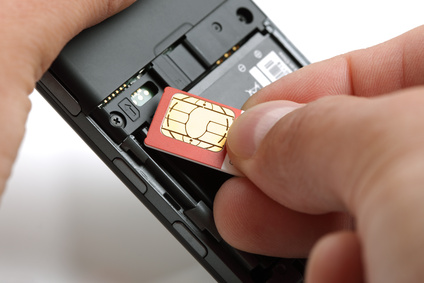
A SIM card, or Subscriber Identity Module, is a small memory card used in cell phones that use a GSM cellular network. GSM stands for "Global System for Mobile Communications" and refers to the type of technology that AT&T, Verizon, Sprint and T-Mobile use in the United States and by wireless carriers in almost every country abroad.
For smartphones using a GSM network, the SIM card is a necessary piece in the operation of your cell phone since it contains your phone number for the carrier you use with your smartphone. The card fits into a slot (usually along the phone's edge) of a mobile phone and contains personal information about the phone's owner. For the phone to read the data on the SIM card, the card must is inserted into the cell phone's SIM slot.
Sizes and Types of SIM Cards
There are three different sizes of SIM cards available on the market, the mini-SIM. micro-SIM and nano-SIM. The micro-SIM is the largest type of SIM card that in use. Smartphones rarely use the mini-SIM, and now almost all smartphones use a micro-SIM, which is considerably smaller, or an even smaller type called the nano-SIM. The three sizes aren't interchangeable; you use the SIM card that fits your cell phone.
While the SIM card is a small piece of plastic with gold colored areas on one side, it contains a small amount of memory on a chip. The memory is sufficient to store your phone number, service provider name (SPN), contacts, text messages and various other data. All SIM cards are internationally identified by what is known as an integrated circuit card identifier (ICCID) and contain a specific serial number.
Verizon, Sprint, and CDMA
Verizon and Sprint in the US built their networks using a type of technology called CDMA (Code Division Multiple Access) that didn't require a SIM card. Smartphones made for Verizon and Sprint didn't have a SIM card slot until both carriers added faster connection speeds.
As Verizon and Sprint updated their technology to 4G (4th Generation), they starting using SIM cards in all of their devices because the 4G technology required a smartphone or tablet to have a SIM card. Verizon and Sprint still maintain and operate their CDMA network of cellular antennas in addition to the faster, newer 4G technology. As a result, a smartphone for Verizon or Sprint will typically have that capability to connect to both their CDMA network and a SIM card for connecting to their 4G networks.
Newer models of smartphones are built to support as many carriers as possible but if you think you may ever want to switch or use your smartphone internationally, make sure that your model will work with a SIM card from another carrier or an international SIM card.
How SIM Cards are Used
The SIM card can be extremely useful. For example, if you travel internationally, you can use your phone if your cellular carrier gives you the ability to install and use a SIM card from another cellular provider. The only requirement is that you purchase a SIM card at your destination, remove your current SIM card (be sure to keep it), then insert the new SIM card into your phone. Then, when you return home, you can go back to your regular SIM card and use your device locally.
To my way of thinking
SIM cards allow you to use your existing phone, or any device with a SIM card, on another cellular network. For international travelers, this can be very convenient, but keep in mind that your phone number will change when you change your SIM card. For some people, the cost of roaming service, which allows you to keep using your existing phone number anywhere, is worthwhile to keep the same phone number. But if you're in a different country for a longer trip, a local carrier's SIM card will save you money compared to international roaming.
Check with your cellular carrier to compare rates and to get information on whether your model of smartphone will work with an international SIM card.
Not a subscriber/ Don't miss a single issue: