
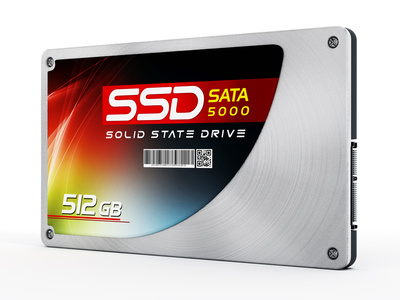
What is a Solid State Drive?
Solid State Drives, abbreviated “SSD,” are storage devices for computers that are usually used to replace a traditional computer hard drive. SSD's offer faster speed and performance than traditional computer hard disk drives.
Traditional hard disk drives have a magnetic disk which rotates on a spindle, and a magnetic read/write sensor which changes the magnetic setting for writing data to the disk and can also sense the magnetic setting to read data. The magnetism of the surface on the disk indicated whether a piece of data is a zero or a one.
The magnetic read/write sensor moves in and out from the center of the hard drive, which rotates. These movements allow the magnetic sensor to access any location on the hard drive surface.
How SSD's Work
Unlike magnetic disks, SSD's use electronic memory circuits to store data, and they're essentially larger versions of USB flash drives. SSD's, like USB flash drives, use a type of electronic circuit that remembers the data even when there's no power to the device. In comparison, your computer's RAM, or Random Access Memory, doesn't store data when your computer is turned off.
This electronic, or "flash" memory is used not only for SSD's and USB drives but on mobile devices such as smartphones and tablets, which don't have any mechanical hard drive and use all electronic memory.
Since there's no mechanical movement in an SSD, it can read and write data faster than a traditional disk, which has to rely on physical movement to access data. Without moving parts, SSD's are quieter (as in silent) and more reliable. However, they are more expensive, when compared to traditional magnetic hard drives.
Should you upgrade to an SSD?
Upgrading from a mechanical drive to an SSD on a computer may not improve all the performance characteristics you want. Performance depends on many factors. Most likely you'll see an improvement in the start-up time for your computer, but application performance may or may not be improved.
To my way of thinking
If you're purchasing a new computer, especially a laptop, it's worth considering buying one with an SSD if your budget can afford it. The quick startup time makes your computer act more like a smartphone or tablet when you want to start using it.
Not a Subscriber? Don't miss a single issue: