
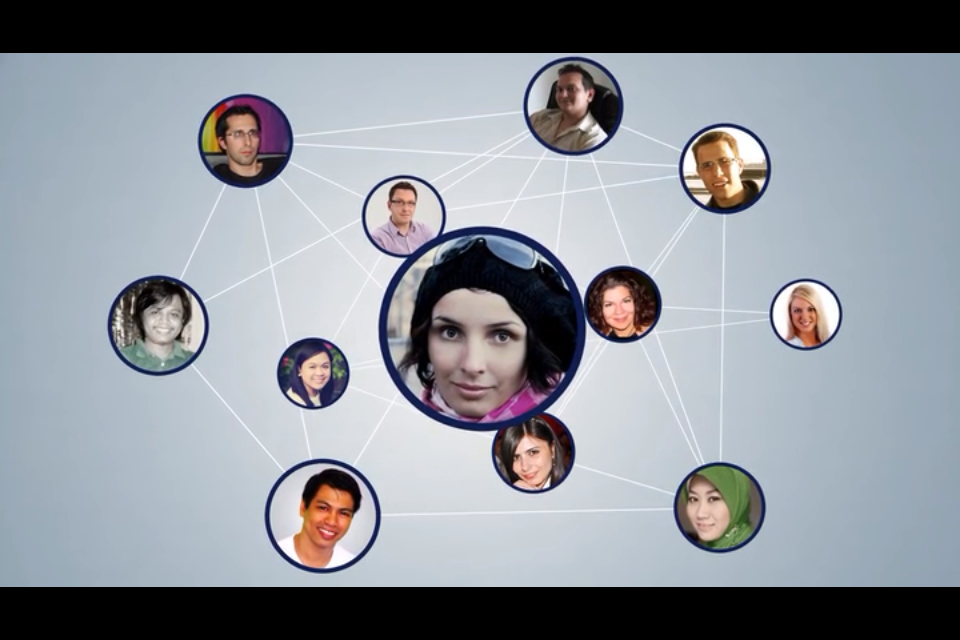
What is a Social Network?
A social network is an online community of people or organizations that join the community, connect with other users, and share content and updates with the community.
Most people know social networks by their names, which include Facebook, Twitter, Instagram, Pinterest, and LinkedIn, and are the among the most popular social networks. I've determined that all of them have three characteristics in common.
The three common features of social networks are: join, connect, and share. Let's take a look at what each of these means and how they create this type of community.
Join
All social networks require a person or organization to join them in order to access the features of the community. This means setting up an online account with the Social Network, usually through a Web site. You provide your email address, create a password, and maybe have to supply your name and one or two other pieces of personal information.
After completing this information, which involves filling in a form on the social network Web site or mobile application, you receive a confirmation email. This email confirmation is an important step and is used to verify that you can receive their email communications. By clicking on a link in the confirmation email, you verify your account. Now you have joined the Social Network and can use all the features available to users.
It's similar to joining many other membership organizations. In order to receive the benefits available to members, you need to join. A credit union is an example of a membership organization. It provides financial services to its members, and in order to take advantage of the services available, for example, a checking account, you need to join the credit union and become a member. Credit unions have members, and members have access to member benefits.
Social networks, since they are online communities, use the web, email, messaging, and other forms of electronic communications to communicate with members. Once you join, you have access to the member benefits. These benefits typically include the ability to connect with other members of the community and share information with them.
Why Are They Free?
All the major social networks are free to join, no money is required. They are, however, profit-making organizations, and they make money by selling advertising to organizations that want to reach the members of the social network.
The fine print in the terms and conditions you are required to accept when you join a social network usually gives the Social Network the ability to collect information about you. This includes your activity while using the Social Network, and also allows them to make money by selling advertising to you. Don't be too shocked though. We are generally willing to give up something for a good deal.
You might have a member card with your grocery store that provides a discounted price on your purchases. In return, the store can collect data on what you buy, when you buy it, and use that to make money by selling shopper information to companies that want to learn more about shopper's behavior. We accept free television shows in return for commercials, and almost everyone has a credit card or ATM card, which includes terms that allow the card company to track our usage and purchases.
Personal information about you is never shared by social networks, but your information is collected so if someone wants to reach men that play golf (like me) the community can give advertisers that option. Your personal information is only used to manage your account by the social network and is never shared.
OK, so if you want to join and use the social network, you setup your account using your email address, create a name you would use in the community (some require your real name, others don't), and then you can use the features of the community, which includes connecting with other users. So now let's move on to the second characteristic of a social network, which is connecting.
Connecting
Since these are, after all, "social" networks, they assume you joined to be social, and not anti-social. The whole point of a social network is to find and make connections with other users.
Other users might be family members, friends, work associates, or a business or organization. All of these can have user accounts on a social network. Ever see or hear an ad that asks you to "like" something on Facebook or "follow" them on Twitter? That's a brand asking you to connect with them. Some social networks treat people and brands the same while others have different types of user accounts for a business compared to a person. Let's see how this might work.
People who are users can connect with other people who use the social network. You might know someone who is already a user on a Social Network like Facebook, Twitter or LinkedIn. You probably have their email address already if they are someone you communicate with on a regular basis. The email address of a user is a key part of finding and connecting with other users.
If you know someone's email address, and they are a member of a Social Network you belong to, you can locate them by searching in the social network search tool using their email address. You might be able to find them by name, location, school, or work history as well, but the email address is the most efficient way and it avoids making mistakes and connecting with strangers. Every Social Network has a way to search for other people, and others can search for you as well.
Once you find someone you know, you can connect with them. This is where social networks are different from each other. A "connection" is different on each Social Network and how it defines a connection gives the social network it's "personality."
Facebook, for example, has people connect to each other as Friends. For two people to become Friends, they both have to agree. So one person sends an invitation, and the other person has to accept it; otherwise, they don't become Friends on Facebook. A friend is the same connection whether they are a close friend or a distant one. The term Friend means that Facebook will share information about you that is only visible to other Friends, and that you will be able to see information about your Friends that is only available to view because you are a Friend. I'll go into the information part when I discuss sharing, so please hold on.
Twitter uses the terms "followers" and "following" for connections on Twitter. Anyone can follow anyone else, with no permission required, so Twitter is a lot more public than other Social Networks. The users who follow you are your "followers." Followers receive updates from the users they are following when they view their account.
LinkedIn uses the term "connections" for connections, which allows a user to communicate and view more information about someone that if they were not a connection.
The social network you use creates a way for people and organizations to share information that isn't visible without a connection to that user. This way, people and organizations don't have to send every one of their connections information because the social network takes care of sending the information to all of the person's or organization's connections.
OK, so this might be hard to understand. Let's say you send out a holiday letter by postal mail to everyone on your holiday card list. Each letter has to be individually addressed, stamped, and delivered. If you have everyone over to your home, you can give them one copy that they can read and view. If you have a sign in front of your house, it's public, but if you have something inside your house that only people you invite in can see, it's more private.
The Social Network you use has rules and resources for what you share with your connections. Facebook requires that you be Friends, Twitter lets anyone follow anyone else, LinkedIn makes your profile mostly visible, but only allows you to send a direct message to another user if you are connected to another user. So now on to what you are sharing.
Sharing
Profile Information
What you share is really up to you, but some social networks, particularly Facebook, want to collect more information about you, your interests, and your activities compared to other social networks. Facebook has a very robust way for you to create a profile about yourself. You can include where you live, where you work, your contact information, and your interests, along with your "Likes." Your Likes are the brands, companies, and organizations that you choose to Like on Facebook.
Twitter gives you 160 characters to describe yourself, so it simply doesn't have room for much information in your profile. LinkedIn is primarily a work-related social network, so your profile is your work history, experience, and skills. Instagram and Pinterest, like Twitter, use short profile "bios."So each site has a little different profile approach. But all of them have "updates."
Updates
An update is a piece of information you publish in your account that is automatically sent to your connections. The information can be some text, a photo, video, or a link to another Web page. You are essentially publishing information on a personal Web site that the social network gives you, and they take care of sending a message to your connections letting them know you've got some new information to share. What you share is up to you.
If you want to share information about a vacation, your work, what you eat, who you see, it's totally up to you. People will learn about you by what you share in your updates. So your updates are like a journal you share, but everyone has a personal style and preference for what they share and how often they share. Social networks usually allow you to share photos, videos, and links to other Web pages in addition to plain text. You don't have to be a writer to share on social media. Using a smartphone app from the social network, you can share your location with your connections since smartphones have GPS chips.
People and Organizations
Depending on the social network, people and organizations may be different types of users, with a different type of connection. When you Like something on Facebook, you are choosing to receive updates from that organization similar to the way you receive updates from your Friends. They don't see any of your personal profile information, or your updates because they aren't your Friend. So Facebook has a way for organizations to create a user account, called Pages, and people can Like a Page. Other Social Networks are similar, but with some subtle differences.
LinkedIn has something called a Corporate Page, which is for corporations and other organizations. People connect with other people, but on LinkedIn, people follow a Corporation. By following a corporation, they can send you a direct message, but you will receive their updates in your LinkedIn account.
On Twitter, Instagram, and Pinterest, all users are the same, whether they are a person or an organization.
Advertising
Social networks I've mentioned are businesses that sell advertising. Their goal is to collect as many users as possible by offering free, useful, and interesting services for their members. With many members, advertisers are willing to pay to reach the members. It's similar to a television show like the Super Bowl. If you're an organization that wants to reach viewers of the Super Bowl on TV you have to purchase a TV ad from the network that broadcasts the Super Bowl.
Advertisers who want to reach as many users as possible on a Social Network are willing to pay to reach you and other users. This is how Social Networks make a profit and how they are able to offer users like us free services.
The benefits of being able to connect and share information with people who live far apart, in different time zones, or just don't see each other that often make Social Media appealing. Human beings are social, with our families, community organizations, towns, schools, and other activities that bring us together. Social Media is just another way, the electronic way that people can be social.