
What is a Motherboard?
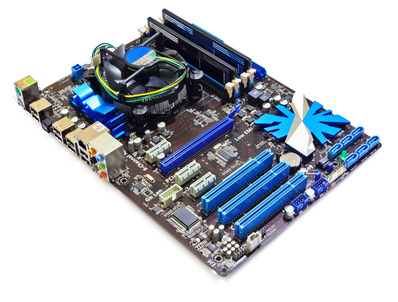
A motherboard is a circuit board with electronic components that allow it to connect all the hardware of a computer together. It is a critical piece of hardware upon which every computer is built.
It's called a motherboard because it's the main chassis in any computer. All the electronic components and hardware that make up the computer connect in some way to the motherboard. Any other circuit boards necessary to build a complete computer are referred to as "daughter" boards. Most personal computers that are built today don't have daughter boards and only use a motherboard, so you don't see the term "daughterboard" used very often.
What a Motherboard Does
Think of a computer as if it were a human body. The motherboard would be the skeleton. It doesn't do much on its own, but without it the body cannot function. Other pieces of hardware perform specific functions the heart pumps blood, the lungs breathe and the brain regulates everything while the skeleton supports them all. This is how a motherboard functions in a computer. It supports and connects the rest of the hardware. Unlike the body, of course, the heart, lungs, or brain of a computer could be swapped out with more powerful versions that still connect perfectly to the skeleton.
Every computer and computer-like device has a motherboard. Television is controlled by a motherboard that has all of its parts permanently connected. You can't open up your television and upgrade its ability to display images. Smartphones are the same, with every necessary piece fixed in place. Laptop computers have most of the parts built-in to the motherboard in order to save space. No one would buy a laptop the size of a desktop PC.
Built-in Components and Upgrades
A basic motherboard can consist of only the electronic wiring necessary to connect all the components of a computer together. Components, like a processor and RAM, are then added to the motherboard to build the computer. To make computers less expensive, or to make them smaller, such as a mobile smartphone, motherboards can include some of the additional components as built-in pieces.
Personal computer motherboards often include built-in sound and graphics components, eliminating the need to add them as separate pieces. This lowers the cost and size of the computer. If a motherboard is custom-built for a manufacturer, such as a tablet or a smartphone, capabilities such as GPS or WiFI might be added to the motherboard. It just depends on who makes the motherboard. Most desktop PCs use a motherboard that do not include the processor, which is added separately by the manufacturer. These motherboards can also be purchased as separate parts if you want to build your own computer.
Desktop PCs have the advantage of upgrades. The motherboard in a desktop has special slots where accessory cards can be inserted. Using accessory cards that can be installed, additional capabilities can be added to the computer for special uses. Some common examples are audio cards, graphics cards, and cards for special connectors. Using accessory cards, a desktop offers the most expandable motherboard. Laptops, smartphones, and tablets don't have space for any additional circuit cards to be plugged in, so any additional accessories have to connect to external connectors.
Connections
Connectors are a part of every motherboard. This is how you might connect a printer to a USB connector, an ethernet cable to an ethernet connector, a keyboard, monitor, mouse, and other devices. The motherboard holds the connectors and provides an electrical connection to the rest of the computer. You just usually see the external connector.
Without a motherboard, there is no computer. A PC, smartphone, tablet, or any computing device would be nothing more than a fancy metal and plastic box filled with useless parts. The motherboard is what connects all the pieces together.