
What is a Lithium-ion Battery?
Lithium-ion (Li-ion) batteries are the type of rechargeable battery commonly used in electronic devices like smartphones, laptops, Bluetooth devices and other personal electronics. They are popular because compared to other types of rechargeable batteries lithium-ion batteries store a lot of energy for their size and don't lose much of their charge when not in use. Because of these and some other characteristics that we'll take a look at, lithium-ion batteries have made portable rechargeable electronic devices more usable.
Battery Basics
All batteries store energy in a portable package so you can use them to power and supply energy in the form of electricity when and where you need it. Batteries have three parts, an anode, which is is the negative end of the battery (the one with the minus sign on it), a cathode (the positive side with a plus sign) and the electrolyte. Connecting the positive and negative sides of a battery to anything that uses electricity, creates an electrical circuit.
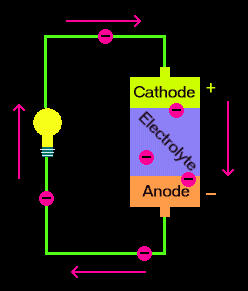
A chemical reaction in the battery causes electrons to collect at the anode (negative) end of the battery. The electrolyte keeps the electrons from traveling back to the cathode, or positive end of the battery. But electrons like to move away from other electrons and would rather go somewhere else than just hanging around with other electrons at the anode side of the battery. In fact, if they could, they'd head toward the cathode end of the battery, but they can't.
The electrolyte is a material that keeps the electrons inside the battery from traveling from the anode side back to the cathode side. Electrolyte keeps those electrons up against the anode, and when the battery is connected to a circuit, the electrons rush to escape and follow the circuit to head back to the cathode end of the battery.
So when a battery is connected in a circuit the chemical reaction sends electrons to one end of the battery, the electrolyte keeps the electrons from heading back and connected the anode and cathode create a new path for the electrons to follow.
Eventually, batteries run out of energy because the chemical reaction that creates the electrons at the anode inside the battery changes the chemical composition of the anode and cathode, so they can't supply electrons, and the battery runs out of power.
When batteries run out of power
In a non-rechargeable battery, when the chemical reaction cannot create power, the battery is out of energy, or in more common words it's "dead.". In a rechargeable battery, the electron flow is reversed during recharging, which restores the battery to its original state so it can supply power again. Supplying power when recharging reverses the chemical reaction so with a charged battery, the chemical reaction that makes power can start again.
Rechargeable battery chemicals
The differences in the chemicals used in batteries create the differences between short-life or long-life and rechargeable and non-rechargeable batteries. Lithium-ion batteries use Lithium material to create the electrons that provide the battery's power and are rechargeable.
Before Lithium-ion batteries became widely used, the most common type of rechargeable battery used was the nickel metal hydride (NiMH) type of battery, which uses a chemical compound consisting of nickel. They have been replaced almost completely by Li-ion batteries because lithium-ion batteries have advantages that make them more useful. So let's look at a few of them so we can understand our Li-ion batteries better.
Characteristics of Lithium-ion batteries
Self-discharge
Batteries will gradually lose their power (called self-discharging) even when not in use. If you don't use an electronic device with a battery connected to it, the battery eventually loses all of it's energy, or charge, even when their not connected to anything. The self-discharge characteristic is why non-rechargeable batteries usually have a date printed on them to tell you how long they will keep their charge and be useable.
Li-ion rechargeable batteries only lose about 1.5-2% of their charge every month when not in use, which is excellent for a rechargeable battery. Higher temperatures can increase the self-discharge rate and even cause long-term damage to your battery so keep this in mind if you store your device and the battery in a hot location. Apple's website advises not charging or storing your battery where the temperature is above 95 degrees or in a very cold environment, below freezing.
Battery Life
How long a battery can supply power is probably the way you think of battery life, after all, if a battery can supply power for 10 hours it should have a longer battery life than a battery that supplies power for 1 hour. However, battery life is commonly used to describe how long a battery will be useful, that is, or how long can the battery be used and still be recharged to its full power. The battery life of a rechargeable battery isn't measured in months or years but in what are called charge-cycles. A charge-cycle is the number of times a battery is charged from zero to full charge. If you charge a 50% charged battery to a full charge you've only used 1/2 of a charge cycle.
Understanding charge-cycles will help you understand more about how to maintain your Li-ion battery. Li-ion batteries have a battery life on average of about 1,000 charge cycles.
If you charged your battery from zero to 100% every day you'd have 1000 days of use out of your battery, or a little more than three years, which is a long lifespan for a rechargeable battery, and a reason so many devices use Li-ion batteries. You might get a little longer life or a little shorter life depending on other factors like heat since the 1000 cycle number is an average.
By the way, most manufacturers (Apple, HP, etc.) say it's no longer necessary or even recommended to discharge a battery completely before charging it, and it's also OK to charge a battery anytime and not worry about the battery life or performance.
Degradation
Degradation is the measure of how much of its full power a battery will store over its lifespan. For example, a new battery that holds 100% of it's rated power has zero variability. Over time, a battery may not recharge to the same amount of power as the battery degrades. A battery that will only charge up to 90% or its original power after three years has a 10% degradation. After about 1000 charge-cycles, Li-ion batteries start to degrade and don't charge up to their original power levels.
To my way of thinking
Lithium-ion batteries have made it possible for us to use smartphones, laptops, tablets, watches and other devices with a long-lasting compact portable power source. Each person uses their electronics differently, so while one person can go for two or three days without charring their device, another user might need to charge their battery twice a day. However, Lithium-ion is a huge improvement over the previous NiMH battery technology.
Keep in mind that many “urban myths” about how to care for batteries are based on people's knowledge of NiMH batteries and not the more commonly used Li-ion batteries. It doesn't hurt to read up on what manufacturers have to say about maximizing battery life, and I've included links for advice from Apple and Hewlett-Packard on maximizing battery life, which apply to almost all Li-ion battery-equipped devices.
Technology changes and the Web is a great place to find up-to-date information from manufacturers about how to care for your electronic devices.
Links to some manufacturers advice on Li-ion batteries:
Apple Maximizing Performance Tips
Hewlett-Packard Maximizing Battery Performance Tips
Not a subscriber?