
What is Wearable Technology?
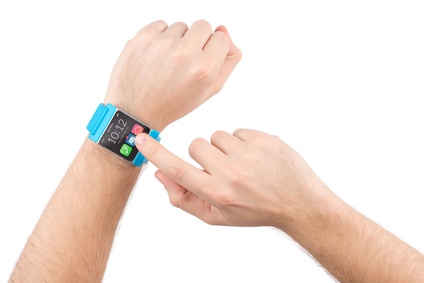
Wearable technology describes any type of device that you wear on your person and has the capability to communicate with some other technology, like a smartphone or computer. As electronic devices become smaller and more portable, their capabilities are being placed in smaller physical packages that can be worn as easily as a watch, a pair of glasses, or a belt. The size and shape of the devices varies widely, but many on the market today are commonly made as a band that attach to a wrist, and might be called a smartwatch.
The advances in miniature electronics technology are making possible many smaller and more powerful devices, so manufacturers are designing and manufacturing more types of devices, and the broader and more general term, "wearable technology" is being used to describe this family of devices.
Using miniature electronic sensors, compact and lightweight wearable technology devices are capable of measuring movement, pulse, heart rate, temperature, and more. Using miniature wireless communications technology, usually Bluetooth, these wearable devices can send this information to another, more powerful device such as a smartphone, or store the data they collect to be transferred later.
Fitness Trackers
Other, more common wearable technology devices include sensors from brands such as Fitbit, Polar, or Nike+ activity tracker bands or clip on devices, or as low-tech as a simple pedometer. These devices are designed to be small and discreet, and can be slipped into a pocket, clipped onto a belt or bra, placed in a shoe, or worn on the wrist.
A basic pedometer, or step counter, contains an internal ball or other object that moves up and down with the person's movement and counts steps based on how much the body shakes. The shaking or movement of this internal ball signals a switch that causes the counter to click forward. Pedometers were first used in Japan during the mid-1960s to promote physical activity. Today they are a popular way to begin a physical fitness program and studies show that people who wear pedometers take more steps per day than those who set a goal to take a brisk, 30-minute walk each day. Step counters can be purchased as individual devices, though most smartphones now contain a similar device as a part of their hardware design.
Digital devices, like the Fitbit, Nike+, or Polar activity trackers, use more advanced programming to gauge a person's movement. They not only keep track of the daily number of steps taken, but can also be used to monitor stairs climbed, distance, calories burned, heart rate and overall activity level through the use of more complex motion sensors and altimeter technology. These high-tech devices can also be utilized to measure how well and how long a person sleeps. This information is logged wirelessly and can be accessed through a website or smartphone app. The user can access these logs to view quantitative data and comprehensive graphs that detail the results. Being able to view this information in real time gives users the ability to take their physical fitness tracking further than the basic pedometer has allowed.
More Advanced Types of Wearable Technology
Wearable technology also includes more expensive and versatile products such as Google Glass or Samsung Galaxy Gear smartwatch, both of which offer software developers the ability to create custom applications. These devices include displays, cameras, touch sensors, and other features that were only available a short time ago only in smartphones.
In addition to all the buzz about consumer-focused wearable technology, commercial and medical uses of wearable technology are expanding rapidly. Companies are using smartglasses that display repair manuals, giving technicians the ability to have both hands free and pull up any documentation necessary when performing a task.
The Future of Wearable Technology
While people wouldn't necessarily want to walk around wearing a computer, people have been wearing technology for a long time, so wearing accessories isn't anything new. It's just that the accessories are changing with technology. Walking around with earbuds or headphones wasn't that common even a few years ago, and today, earbuds and headphones are a style accessory.
Since glasses and watches are two commonly worn accessories, both of which are socially acceptable, expect to see more advances in these two areas of wearable technology as manufacturers look for the right fit of price, style, and function that the consumer finds appealing. However, be prepared for some surprises that no one will be able to predict, including me!
Not a subscriber? Don't miss a single issue: