
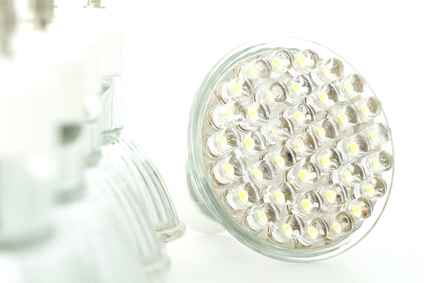
What are LEDs and LED Light Bulbs?
Light Emitting Diodes, or LEDs, is a type of light source that produces light from a silicon wafer made up of two different materials. When an electrical voltage is applied to the LED, it emits light. In the past LEDs were used primarily for small lighting uses, such as an indicator light on a display panel or a number or letter display. Advances in LED technology have resulted in their use as a light source for general home lighting, automotive, aviation, traffic signals, and advertising displays. So what makes an LED light source an LED?
LED's are semiconductor circuits
LEDs are a type of electrical component known as a diode. A diode is a one-way type of electrical component. Diodes resist electric current in one direction but do not resist current flow in the other direction. The use of the two different materials creates this one-way direction for the current. When a voltage is applied to a diode, electrons move from one side of the diode to another. When an electron moves to the other side, it loses some energy that in LED's is released as light in the form of a photon. LED”s are different from other types of diodes since the electrons generate light when they release energy while other types of diodes and circuits generate heat.
The color of the light, (or more properly the wavelength) depends on the materials used in the LED. When LEDs were first invented, they were made with a type of material called gallium arsenide, which produced infrared and red LEDs. That's why when they first started appearing they were always red in color. Now, other materials are used in LEDs to produce white light and other wavelengths.
As LEDs have become lower in cost and are designed to generate light that is similar to familiar incandescent light bulbs, LED light bulbs have become available in sizes and shapes for home and commercial uses.
Since individual LEDs are small in size and one LED can only generate a little bit of light, a 60-watt LED light bulb uses many individual small LEDs that together create the equivalent light output of a 60-watt light bulb. By putting multiple LED lights into a lamp, engineers can create LED lamps for almost any use. But one of the biggest reasons LEDs are being used so much is due to their energy efficiency compared to other types of lighting.
Efficiency
The efficiency rating of a light source is measured by how many lumens of light are emitted per watt of energy. A lumen is a consistent measure of the total amount of light emitted by a light source. You may see lumens used on light bulb packages, and it's actually a more accurate way to tell how much light a bulb produces since lumens are independent of wattage or the type of light source. A 100 lumen light source will be consistent regardless if the light is incandescent, fluorescent, or LED.
So when it comes to efficiency, the real way to judge a light source is by how many watts of electrical current it takes to create one lumen. Let's compare the percentages of three common lighting sources, incandescent, fluorescent, and LED.
A typical incandescent bulb has about a 10 percent watt to lumen output. So for a 100-watt incandescent bulb, only 10 watts are being used to produce light, the other 90 watts are producing heat, which is why lit-up incandescent light bulbs are hot when you touch them.
Common fluorescent light-bulbs (also known as Compact Fluorescent Lights or CFL's) are more efficient than incandescent lights and have been commonly used as incandescent replacements. A CFL light has efficiency from 45 to 80 lumens per watt, so they are pretty efficient and much more than incandescent lights. The reason for the wide range of efficiency depends on the design and technology used in the lamp. CFL lights have been used as incandescent replacements since fluorescent technology is very common, and the cost of the bulbs was fast to come down in price. There are some trade-offs for fluorescent lights however since they don't mimic the warm lighting from incandescents that are preferred by many people, and they aren't as easy to dim.
Both incandescent and fluorescent light sources have another issue when it comes to efficiency and that's the fact they emit light in all directions. Light bulbs and lighting fixtures for incandescent and fluorescent lights are designed to focus the light in one direction (like a reflector) or diffuse it, like a lampshade.
So how efficient are LED's?
A typical LED bulb generates at a minimum 80 lumens of light per watt, and the lumens per watt generated is increasing with new LED technology. In fact, the US Department of Energy has established a target for commercially available LED's to produce over 200 lumens per watt by 2025. Cree and Philip have both demonstrated prototypes that achieve this level of efficiency. But LEDs have other benefits besides energy efficiency.
LEDs last far longer than incandescent or fluorescent lights, usually for tens of thousands of hours of continuous use. Because LEDs give off light in one direction, it's easier to create lamps and fixtures since the LED's inside the lamp can be shaped to create the direction of light output. LED's have more advantages as well.
LEDs are also more accurate in the color of the light so creating a lighting effect based on warm or cool lighting, or duplicating sunlight, it is easier with LEDs. And one of my favorites is that LEDs are dimmable just like incandescents, which was a drawback to fluorescent lighting. You might have to change your dimmer switch to one that works with LED's, but you'll have the same level of precise control when dimming an LED light as with an incandescent.
To my way of thinking
The Department of Energy (DOE) reported in 2013 that there were over 105 million LED lights in use, a doubling over 2012. As of 2013, the DOE LED's saved over $1.8 Billion in annual energy costs, a number that is increasing rapidly with lower-cost LED's making their away into homes and businesses, with 60-watt equivalent LED lamp available for a price below $10 and often at a lower cost if your local electric utility offers a subsidy.
As LED's come down in cost and replace older, less efficient lighting, they will result in cost savings, less reliance on imported oil, and less waste since they last longer. The DOE also supports research for improved LED technologies since their benefits will help everyone.
Phillips has an LED light called the Philips Hue that changes color and can sync with the SyFy cable network using an app called SyFy Sync. When you connect the Phillips LED lamp to the app, the app adjusts the lighting in your home while you're watching shows like 12 Monkeys, Defiance, and others on TV for a complete “environmental” lighting effect.
Not a subscriber?