
Shopping for Your Work From Home Technology, Workspace, and Supplies
From your computer or laptop to accessories like headsets and webcams, many products are available that can make your work from home technology choices seem limitless. I use a couple of tricks that I'll share with you for making the best choices, save you time, and money.
Buying a product or service based on reviews is pretty standard today. Online marketing researchers estimate that over 90% of people read a review before purchasing a product. But can they be trusted? And how do you know if the rating is impartial or biased in some way? Let's find out about reviews.
Shopper Reviews
People who have purchased or used the item usually write reviews on shopping sites. I call these "shopper" reviews. People just like you and me write them. Many are worthwhile, but some could have an interest that creates a bias. In addition to purchasers, family members, employees, and partners can al freely submit reviews.
Shopper reviews are often written on the use of an item at the time it's opened, rather than use over time. So durability and reliability are not always included in the reviews. Buyers also often only look at the overall rating of a product or service and don't always read individual reviews.
A product with no reviews could potentially be as good or better than a product with many reviews, but our brains tend to conclude that an item with no or few reviews is something we should avoid. Our natural tendency is to go with the crowd. I always read a few reviews of any product to see what people say about it, and I recommend that as well.
Expert Reviews
Sometimes a reviewer is an expert in a particular field, like a professional photographer, an award-winning quilter, or a journalist or blogger who covers a topic. Expertise in any endeavor creates some credibility of the reviewer, and often these types of reviews are in online publications. An expert's opinion is still an opinion.
Comparison Testing Reviews
Organizations that purchase items, then put them through tests to compare them with other products. You might have seen a road-test of vehicle, often done by a publication. The journal evaluates the car using a specific set of test criteria, like comfort, acceleration, gas mileage, then compares the vehicle to others they have tested.
One resource I use that does testing is Wirecutter, a website run by the New York Times. Wirecutter does testing of technology products and services and on items like bedsheets, kitchen appliances, apparel, toys, and more. Wirecutter purchases as many things for comparison as they can then put them through a standardized testing process.
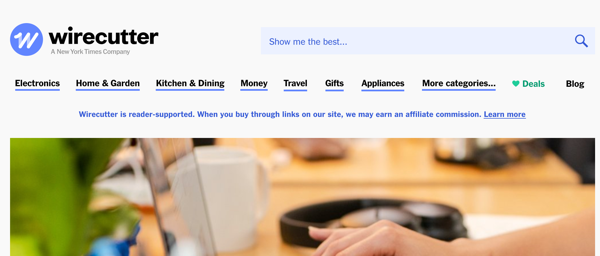
Wirecutter usually comes up with three recommendations. One is the top-recommended item, the one with the best all-around value. Then there's a budget pick and an upgrade pick. Links on Wirecutter take you to where you can purchase the product on popular shopping sites.
Wirecutter is transparent about how they make money and state on their site that they are paid a commission from the shopping cart site. There's no extra charge, the shopping site pays Wirecutter for sending them a customer, and you'll pay the same price if you go directly to the shopping cart site.
While Wirecutter receives payment from the shopping cart for a customer referral, they do seem impartial and what I think in an excellent job in evaluating products. Since they have a history of reviewing may products, they can compare an item's performance over time. They're one of my go-to sites for reviews.
Non-Profit Reviews
One standby in the area of product and service reviews is the non-profit Consumer Reports (CR). Consumer Reports, established in 1936, has the goal of protecting consumers by evaluating products without any advertiser influence. As a non-profit, they perform impartial reviews of products using laboratory-developed testing procedures. Products and services tested include cars, electronics, cellular services, financial products, retail stores, insurance, food, and more.
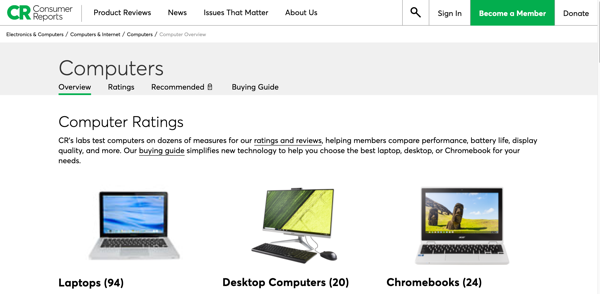
Using tests developed in their laboratory, they evaluate every product that's purchased. CR doesn't take company supplied products for reviews and purchases from retailers just like you and I would,
CR's complete reviews are available to paid subscribers and rank all the items from top to bottom. Products earn a "recommended" rating if they score above a certain level, and some are rated a "best buy" if they score well and have a reasonable price. CR's online site will refer you to shopping carts where you can make purchases, and similar to Wirecutter, CR is paid a commission on any purchase by the shopping cart, not the maker.
Evaluating Reviews
When I'm shopping for an item, I typically will go to Consumer Reports and Wirecutter. Each one has a different emphasis on reviews, and CR ranks all products they test, including ones that they will list as "not recommended." Wirecutter doesn't list reviews of all the products they test, but narrows down the choices, typically three. So these are my stating places.
After I read these reviews, I'll visit the shopping sites and take a look at the products. Usually, the items ranked high by CR and Wirecutter have many excellent reviews, which is what you'd expect. If I find an authoritative blog or publication, I'll also read that.
Each type of review has a bias in its way. For technology, home office, products, services like cellular, or software, I'd say I have been satisfied almost all of the time with any purchase I've made using this process.
It works for me, but it's not for everyone. Sometimes a recommendation from a friend can be the best review if it's someone you trust, and they have experience with a product or service. It's always essential to evaluate the source of any evaluation and ultimately up to you to decide if it's one you want to follow.