
How Computer Chips are Made
Your smartphone, laptop, car, microwave, and even some toys all have something in common: computer chips. These tiny pieces of technology quietly control much of modern life, yet most of us have no idea where they come from or how they're made.
Let's pull back the curtain—without getting technical—and look at how chips are manufactured and why different kinds of chips are used for different jobs.
What Is a Computer Chip, Really?
A computer chip (made from a material called a semiconductor) is a small piece of silicon that acts like a tiny brain. It processes information, follows instructions, and helps devices make decisions—like when to display a photo, heat food, unlock a door, or keep a car from skidding.
Some chips are incredibly powerful. Others are very simple. What matters is what the chip is designed to do.
Step One: Starting With Sand
It all begins with sand.
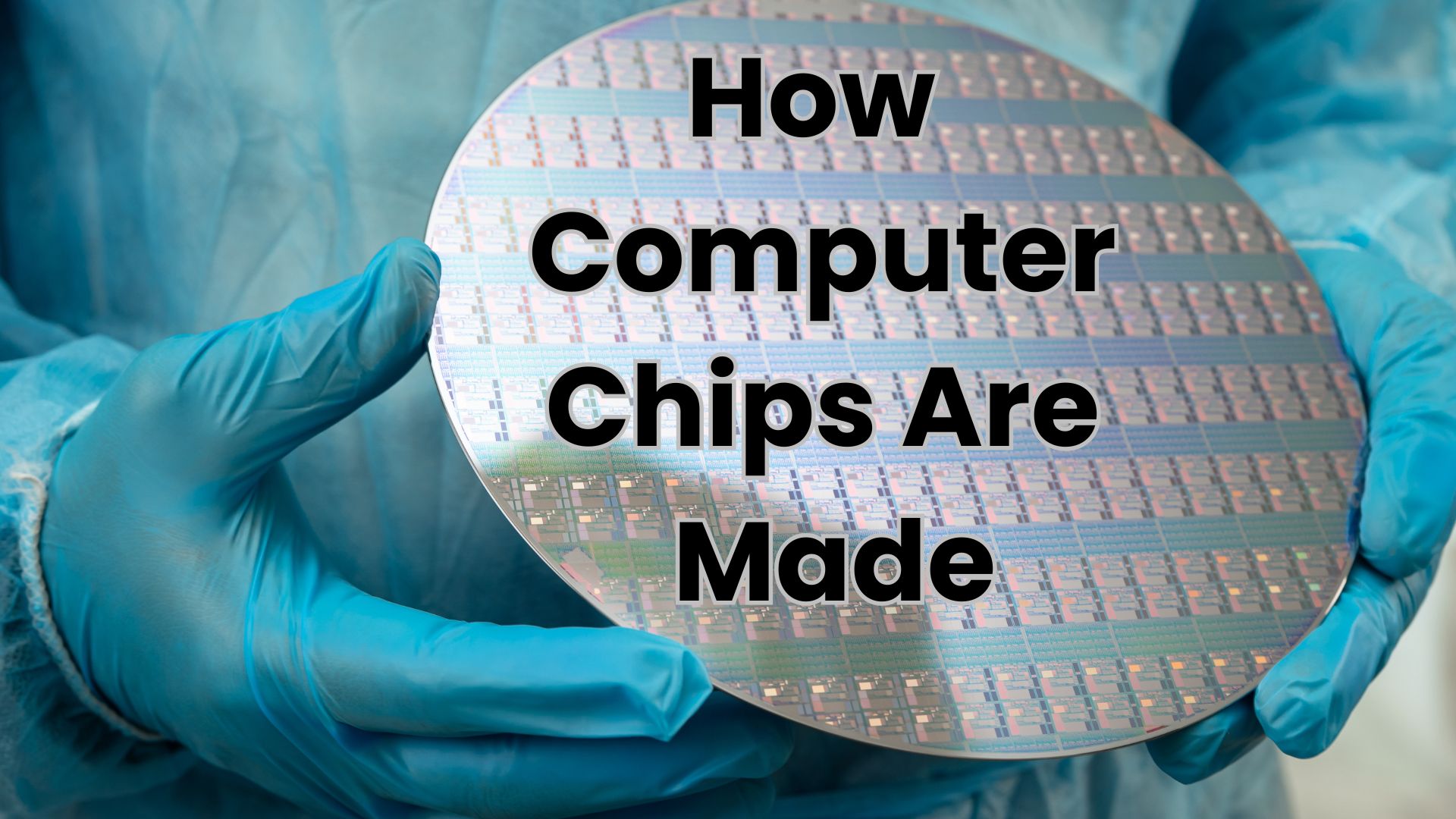
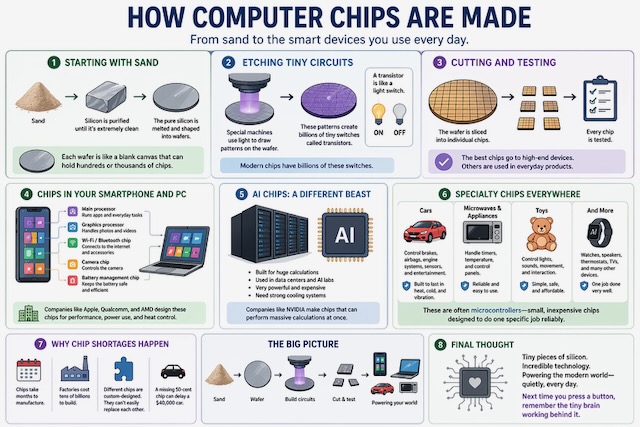
Silicon, the main ingredient in computer chips, comes from sand. That silicon is purified until it's almost perfectly clean—far purer than anything you'd see in nature. The purified silicon is then melted and formed into large, flat discs called wafers—about the size of a dinner plate.
Each wafer will eventually hold hundreds or even thousands of chips.
Step Two: Etching Tiny Circuits
This is where things start to sound like science fiction.
Manufacturers use light-based patterning machines to etch microscopic patterns onto silicon wafers. These patterns form billions of tiny switches called transistors. Each transistor is like a light switch that can be on or off.
Modern chips have billions of these switches.
Companies such as TSMC and Intel operate factories—called fabs—that cost tens of billions of dollars to build and must be kept cleaner than hospital operating rooms.
Step Three: Cutting and Testing
Once the wafer is complete, it's sliced into individual chips. Each chip is tested. The best-performing chips are often reserved for high-end uses, while others may go into more everyday devices.
Many chips that don't meet top performance standards can still be used for simpler tasks.
Chips in Your Smartphone and PC
Your phone and computer usually contain several different chips, not just one:
-
A main processor that handles apps and everyday tasks
-
A graphics processor (often built into the main chip) that handles photos and video
-
Chips for Wi-Fi, Bluetooth, cameras, and battery management
These chips are designed to balance performance, power use, and heat, because nobody wants a phone that drains its battery or overheats in their pocket.
Companies like Apple, Qualcomm, and AMD design many of these chips specifically for consumer devices.
High-End AI Chips: A Different Beast
AI chips are built for a very different job.
Instead of running email or web browsers, AI chips are designed to process huge amounts of data simultaneously, which is exactly what artificial intelligence needs.
These chips are used in:
-
Data centers
-
AI research labs
-
Advanced cloud services
Companies like NVIDIA focus on chips that can perform massive parallel calculations. They're powerful, expensive, and often require serious cooling systems.
You won't find these chips in a toaster—and only specialized or high-end computers use the most powerful versions.
Specialty Chips: Cars, Microwaves, Toys, and More
Not all chips need to be fast or fancy.
Many everyday devices use simple, reliable chips that do one job very well:
-
Cars: Chips control braking systems, airbags, engine timing, parking sensors, and entertainment systems. These chips are designed to last for years in heat, cold, and vibration.
-
Microwaves & appliances: Chips handle timers, temperature sensors, and control panels.
-
Toys: Chips control lights, sounds, movement, and basic interaction.
These chips don't need to be cutting-edge. What matters is durability and cost, not raw speed. Many of these simpler chips are called microcontrollers—they're small, inexpensive chips designed to do one specific job reliably.
Why Chip Shortages Matter
You may remember hearing about chip shortages in recent years. That's because:
-
Chips take months to manufacture.
-
Fabs are extremely expensive to build.
-
Different chips are custom-designed, so one type can't easily replace another.
A missing 50-cent chip can delay a $40,000 car.
Wrap-Up
Computer chips aren't just “computer parts.” They're custom-designed brains, each built for a specific purpose—from powering AI systems to making your microwave beep.
The next time you use your phone, drive your car, or heat leftovers, you're relying on tiny pieces of silicon that went through one of the most complex manufacturing processes humans have ever created.
And most of the time? They just quietly do their job—without us ever noticing.
Frequently Asked Questions About Computer Chips
Are all computer chips basically the same?
No. Chips are designed for very specific jobs. A chip in a smartphone is built to save battery life. A chip in a car is built to survive heat and vibration. An AI chip is built to do massive calculations very quickly. They may all be “chips,” but they're not interchangeable.
Why can't companies make more chips when there's a shortage?
Making chips takes time—often several months from start to finish. The factories that make them cost tens of billions of dollars and require extremely specialized equipment. You can't quickly ramp up production the way you can with many other products.
Why are some chips so expensive?
High-end chips, especially AI chips, require advanced manufacturing techniques, extreme precision, and years of research. The more powerful and efficient the chip, the harder and more expensive it is to make.
Do older or simpler devices still use new chips?
Yes. Even simple devices use newly manufactured chips—but they're often based on older, proven designs. This keeps costs down and improves reliability, especially for appliances, toys, and industrial equipment.
Why are chips measured in “nanometers”?
The nanometer number refers to the size of tiny features inside the chip. Smaller numbers usually mean engineers can fit more transistors into the same space, thereby improving performance and efficiency. For everyday users, smaller usually means faster and more power-efficient—but also more expensive.
Can a chip wear out over time?
Chips don't wear out like mechanical parts, but they can fail due to heat, electrical stress, or manufacturing defects. In most consumer devices, chips are designed to last many years—often longer than the device itself.
Why does my phone feel faster after a chip upgrade?
A newer chip can process tasks more quickly, handle better graphics, and use power more efficiently. That's why newer phones often feel snappier even when the apps look the same.
Will AI chips eventually be in everyday devices?
They already are, in simpler forms. Many phones and computers now include small AI processing units built into the main chip that handle tasks such as photo enhancement, voice recognition, and spam filtering. The very large AI chips used in data centers will mostly stay behind the scenes.
FREE MEMBERSHIP NOW AVAILABLE
Join my new Tech Explorer Community for weekly Tech Topics, AI Topics, Q&A, and more.