
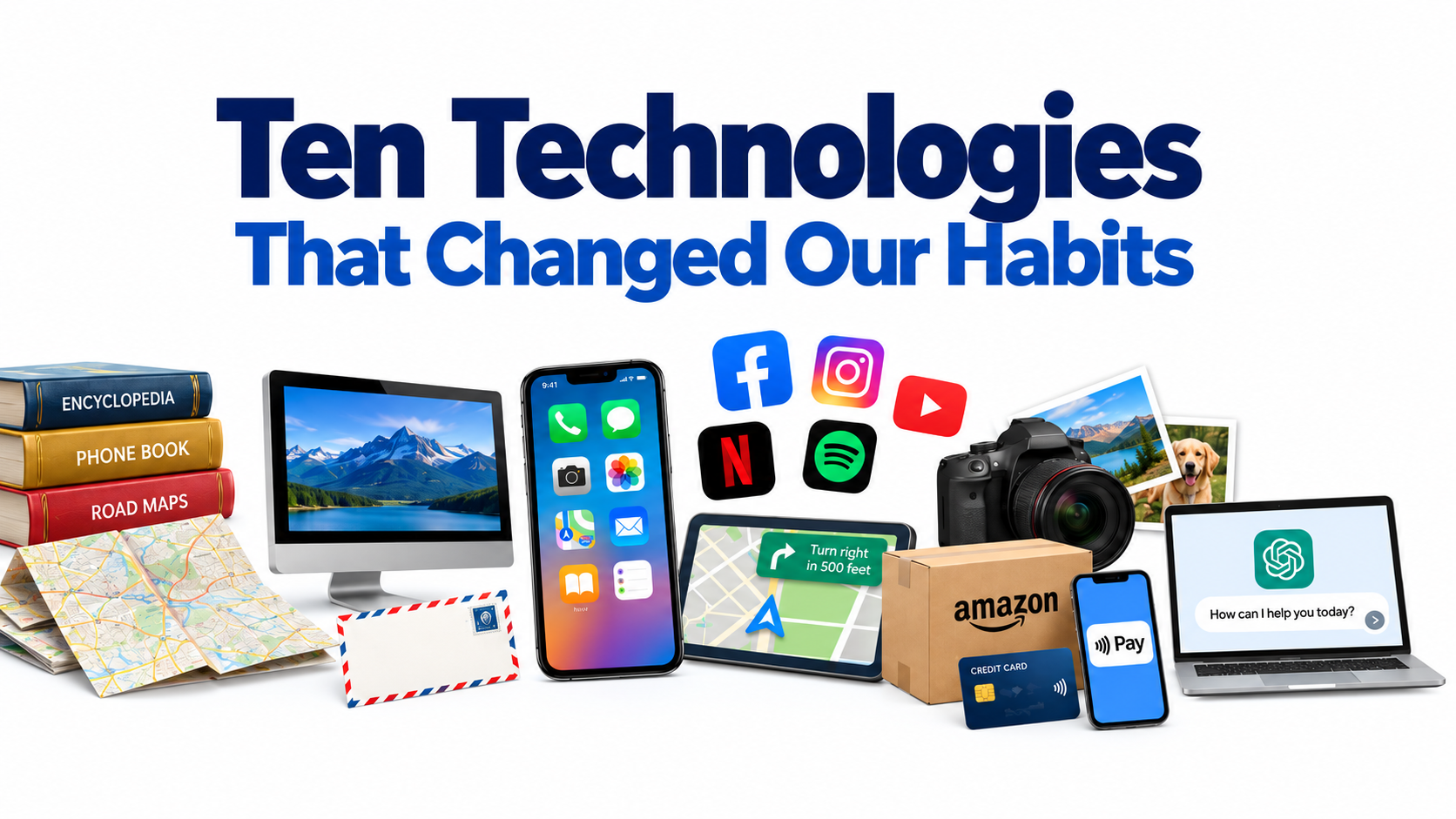
10 Technologies That Quietly Changed Our Everyday Habits
Think about the way you lived 30 or 40 years ago.
You probably looked up phone numbers in a phone book, carried paper maps in the car, waited to have photographs developed, went to a store when you wanted to buy something, and planned your evening around the time your favorite television program was on.
None of those things seemed inconvenient. They were how life worked.
Then technology began changing not only the gadgets we used, but our habits.
That is what makes a technology truly disruptive. It doesn't just give us a new device. It changes what we expect and how we behave.
Here are ten technologies that did exactly that.
1. Personal Computers — Computing Comes Home
There was a time when most people never touched a computer. Computers were enormous machines used by governments, universities, and large companies.
Personal computers changed that.
Suddenly we could write letters, keep financial records, play games, create documents, and eventually communicate with other people from a computer sitting on a desk at home.
The biggest change wasn't simply owning a computer. What you once did on a computer gradually became something you started to do on a screen. I
2. The Internet and World Wide Web — Information Comes to Us
Before the Internet, finding information often meant going somewhere.
You might visit a library, look through an encyclopedia, call a business, read a newspaper, or ask someone who knew the answer.
The web completely changed that habit.
Today, when we're curious about something, our first instinct is often to reach for a phone or computer.
Restaurant hours, medical information, travel planning, news, recipes, directions, product reviews, and millions of other things are only a few taps away.
We have gone from searching for where information is stored to expecting information to come to us almost immediately.
3. Email — Communication Stops Waiting for the Mail
For generations, written communication meant putting something in an envelope, adding a stamp, and waiting several days for it to arrive.
Email reduced that wait to seconds.
It also changed how much written communication we send.
A question that might never have been worth writing a letter about can easily become a two-sentence email.
Eventually, email also became much more than personal correspondence. Bills, receipts, airline confirmations, appointment reminders, newsletters, and business documents all began arriving electronically.
The mailbox outside our homes didn't disappear, but another mailbox became part of everyday life.

4. Smartphones — The Computer Goes Into Our Pocket
Early mobile phones solved one basic problem: they let us make a phone call away from home.
The smartphone changed something much bigger.
It combined a telephone, camera, map, music player, calculator, calendar, alarm clock, web browser, email device, and dozens of other tools into one small computer we could carry everywhere.
That created a completely new habit.
Whenever we need something — information, directions, entertainment, a photograph, a ride, or a message — many of us automatically reach for our phone.
It has become the remote control for much of our daily lives.
5. Social Media — Everyone Becomes a Publisher
Before social media, most of us consumed information created by newspapers, television stations, magazines, and other professional publishers.
Social media turned that model on its head.
Suddenly almost anyone could publish photographs, opinions, videos, announcements, and news for friends — or potentially millions of strangers.
Facebook, Instagram, YouTube, TikTok, and similar services changed how we keep up with family and friends and how we discover information.
There is a downside, of course. When everyone can publish, not everything we see is accurate.
That makes deciding what to trust an increasingly important digital skill.
6. GPS — We Stop Getting Lost the Old-Fashioned Way
Remember unfolding a paper road map across the passenger seat?
Or writing directions such as, “Turn left at the gas station, go about two miles, and look for the blue building”?
Global Positioning System technology, better known as GPS, completely changed navigation.
Smartphones eventually made turn-by-turn navigation available to almost everyone.
Today we often leave for a place we have never visited without studying the route at all. We enter the destination and follow the instructions.
Our new habit isn't remembering how to get somewhere.
It's trusting the phone to tell us.
7. Streaming — Entertainment Stops Following a Schedule
Television used to tell us when we could watch something.
If your favorite program aired Thursday at 8:00, you watched it Thursday at 8:00.
Streaming reversed that relationship.
Services such as Netflix, YouTube, and others let us decide what to watch and when.
Music followed the same path. Instead of buying individual records, CDs, or downloaded songs, we can choose from enormous online libraries.
We've gradually moved from owning entertainment to accessing it whenever we want it.
8. Online Shopping and Digital Payments — The Store Comes to You
Shopping once almost always required going somewhere.
You drove to a store, found the product, stood in line, paid, and brought it home.
Online shopping changed that routine.
Now we can compare products, read reviews, place an order, and have something delivered without leaving the house.
Digital payments changed another habit. Credit cards, phone-based wallets, banking apps, and services such as PayPal increasingly join cash and checks.
The transaction is still taking place. We see less and less of the physical money involved.
9. Digital Photography — Pictures Become Almost Free
Film cameras encouraged us to be selective.
A roll might contain only 24 or 36 photographs, and every picture cost money to develop whether it was good or bad.
Digital photography removed that limitation.
Then smartphones put a surprisingly capable camera into nearly everyone's pocket.
The result was a dramatic shift in behavior.
Instead of saving photographs mainly for vacations, birthdays, and holidays, we photograph restaurant meals, parking spaces, receipts, pets, products at stores, and dozens of other ordinary moments.
We don't just take more pictures. We use pictures differently.
10. Artificial Intelligence — Computers Begin Helping Us Think
Artificial intelligence represents another important change.
Traditional computers mostly waited for specific instructions. We clicked buttons, opened programs, typed commands, and told the computer exactly what we wanted it to do.
Today's artificial intelligence can work with much more ordinary language.
We can ask it a question, have it explain something, summarize information, translate languages, help write a message, create an image, or brainstorm ideas.
That's the beginning of a new computing habit.
Instead of always asking, “Which button do I push?” we can increasingly start by asking, “Can you help me do this?”
AI is still developing, and its answers aren't always correct. Learning when to trust it — and when to double-check it — will become an important skill.
Why It Matters
Looking at these technologies together reveals something interesting.
The biggest changes aren't really about the technology.
They're about us.
-
We stopped memorizing as many phone numbers because our phones remember them.
-
We stopped planning television schedules because streaming waits for us.
-
We stopped carrying maps because GPS tells us where to turn.
-
We take hundreds of photographs because taking another picture costs almost nothing.
-
And now AI may change the way we search for information, write, learn, and solve everyday problems.
-
Technology doesn't simply replace an old gadget with a new one. Over time, it changes what feels normal.
-
That's why looking back can be so useful. It reminds us that many technologies that once seemed strange or complicated eventually became ordinary parts of everyday life.
-
AI may feel like a huge change today. But we've been through major technology changes before.
The gadgets change.
Then our habits change.
And eventually we wonder how we ever did things the old way.
Frequently Asked Questions
What makes a technology “disruptive”?
A disruptive technology changes more than the device or service we use. It changes an established way of doing something. GPS didn't simply replace paper maps, for example. It changed how we plan and remember routes.
Do older technologies disappear when something new arrives?
Usually not completely. People still send letters, use cash, listen to the radio, watch broadcast television, and use printed maps. New technologies generally give us additional choices, although one choice may eventually become much more common than another.
Is artificial intelligence likely to change our habits as much as smartphones or the Internet?
It is too early to know exactly how large the change will be, but AI is already changing how people search for information, write, create, learn, and interact with computers. The important thing isn't predicting every change. It's becoming comfortable enough with the technology to decide where it is useful in your own life.